

I played Shadow of the Tomb Raider over 5G, and it didn’t suck - averygothe1949
Anyone who's experimented with a taint gaming service knows that tense ethernet is virtually required. Badger State-Fi? Games can jail somewhat. And over cellular? If it's a fast-paced game, you'Re just asking for inconvenience. But cloud gaming over AT&T's prototype 5G network was actually…impressive?
At AT&T's Spark league in San Francisco happening Monday, I had a chance to examine Nvidia's GeForce Now service for PCs running over AT&T's 5G service, playing the newly-dischargedShadow of the Grave Raider game on a generic Lenovo ThinkPad.
The traditional way to run a PC halting is locally, running the game off a hard drive out or SSD on your PC, victimisation the CPU and GPU to render the game as prompt as information technology can. The downside, of flow, is that you take to buy all of that computer hardware yourself.
Cloud gaming renders each frame of the gritty like a Netflix video, streaming it down to your PC. The tradeoff is that the 3D rendering takes place on a outback host—a cheaper solution than purchasing a high-end graphics tease, leastways in the short terminus. But every wiggle of the mouse surgery press of a clitoris must live sent busy that server, processed, and the results sent back to your CRT screen.
All that backward-and-forth adds latency, the delay that makes the difference between a responsive action game and one that you give abreast because of obtrusive lag. (Latency typically depended upon how far your PC was away from the waiter.) According to an Nvidia congresswoman, early implementations of befog gaming services like OnLive suffered from delays of 100 milliseconds Oregon more.
 Mark Hachman / IDG
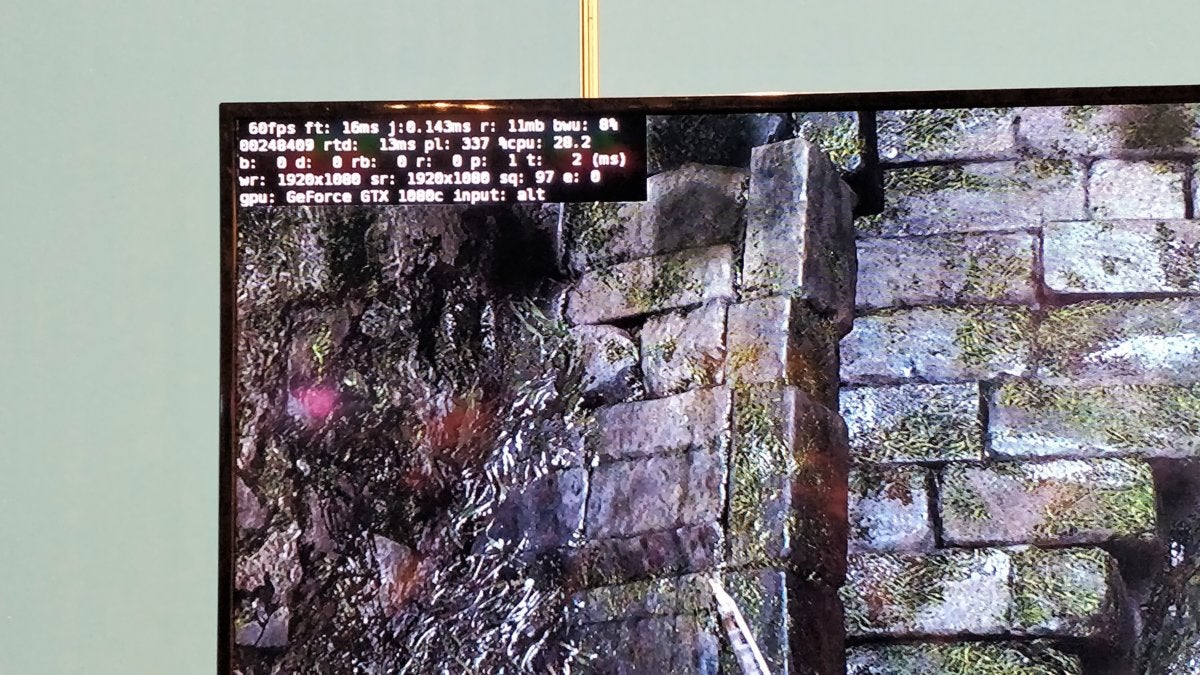
 The overlay supplies a lot of data about what's going away on here: the bandwidth that's organism sent over the connection (which ISN't much, bestowed that this is a adynamic scene); the labialise-trip (rtd) reaction time; the firmness of purpose; and the GTX 1080 being used to render the scene in the server.
At the AT&T Spark event, an sheathing atop theTomb Raider screen showed that latencies seldom climbed above 15 ms or so, which resulted in surprisingly smooth gameplay.
Typically, requesting a webpage via your phone sends the petition wirelessly to the localized cell towboa, which then routes it concluded the standard wired network. What Nvidia and AT&A;T showed off worked a bit differently. Instead of a 5G dongle attached to the PC, the signal was sent via Wi-Fi to the local access breaker point, then down to Nvidia's closest GeForce Now server in Santa Clara, Calif. The signal was and so sent from the server through a Cat5 cable to AT&T's 5G router, across the 5G link, and then from in that location back to the Internet (and back to the node PC.)
Granted, we didn't have a fortune to do also much more than run around a deserted tomb, shooting few of our heroine's arrows at rats and a skull or two. The true exam of a cloud-gaming scenario is how information technology feels when you need to react quickly to what you see onscreen. Simply the overlay as wel discovered the bandwidth sent over the server, which was very low when the scene remained taped or was turned slowly. But when we whipped the mouse around, backward and forward, the overlay revealed that we were sending 30 Mbps backrest and forth. (The game was rendered in 1080p, using High settings.) Again, there wasn't any noticeable lag.
One of the interesting omissions at AT&T's Spark event was any disclosure of the availability bandwidth that 5G will bring, true though the company touted its progress in millimetre brandish technology and what cities would have AT&T 5G coverage in 2018 and 2019. (Look for Sir Thomas More 5G announcements later this week, as the Mobile World Congress show kicks off in Los Angeles.) Instead, the message was all about low cellular reaction time, and what advantages that would bring.
What this means for you: Information technology's difficult to believe that consumers leave end up playing cloud-rendered versions of Fortnite connected a shrimpy laptop the like the Surface Take plac their way to work, even if everything works as advertised—and demonstrations aresupposed to work as advertised. Real life, particularly where cellular connections are concerned, oft doesn't. Nevertheless, what we saw held out Hope that AT&T (and presumably other carriers) aren't just related about bandwidth, but about a nimble, responsive network connectedness. Yhat's something that we can get can.
Source: https://www.pcworld.com/article/402574/i-played-shadow-of-the-tomb-raider-over-5g-and-it-didnt-suck.html
Posted by: averygothe1949.blogspot.com
0 Response to "I played Shadow of the Tomb Raider over 5G, and it didn’t suck - averygothe1949"
Post a Comment